

The real enemy isn’t practicality — it’s “creative" as an excuse for the impractical
Creativity ↔ pragmatism isn’t a spectrum. It’s the design brief.

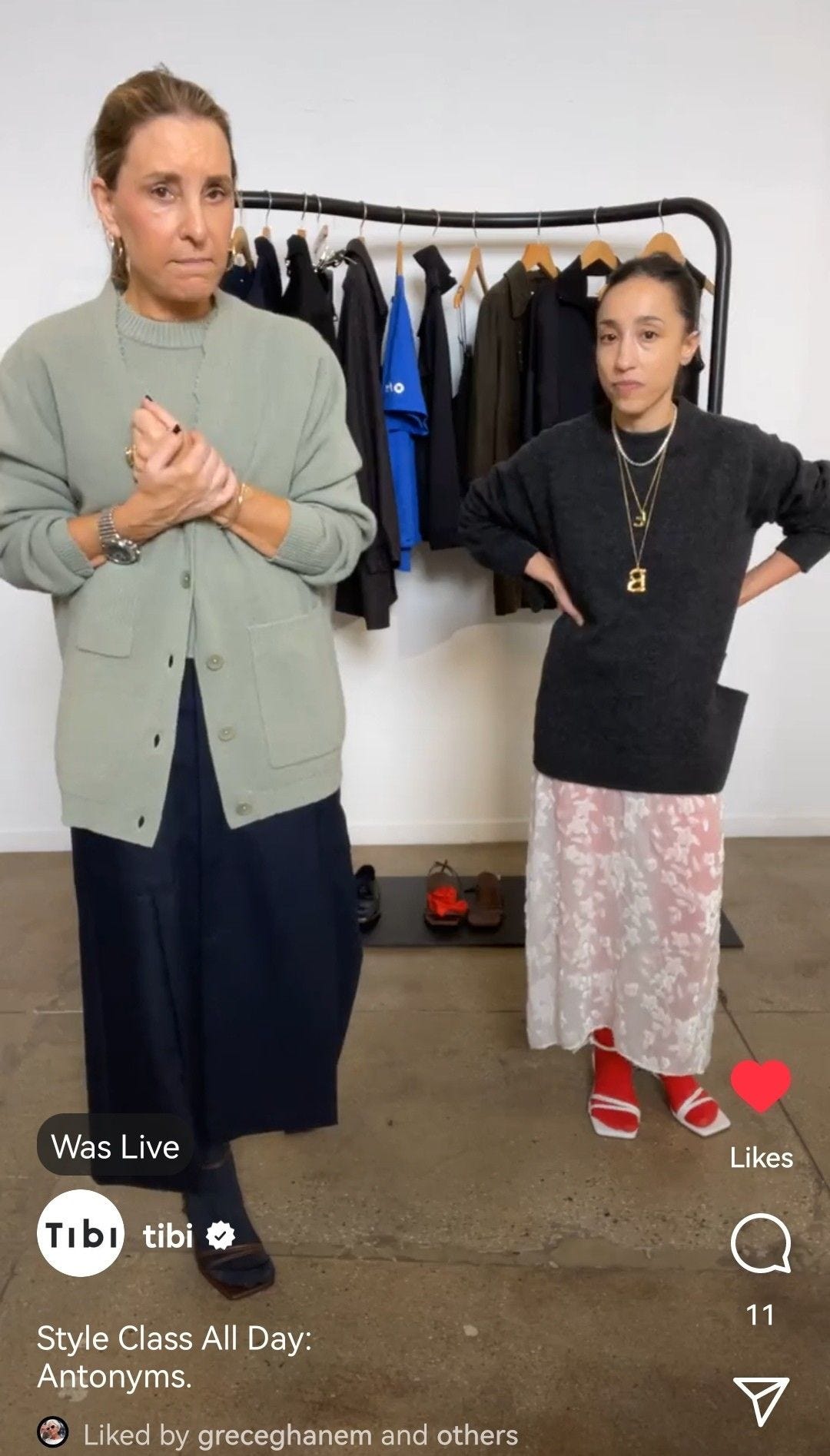
Thanks to Tibi (#notsponsored) and Asta Hearts @ Fit Happens for the provocation that encouraged me to put these thoughts down.
NYC-based fashion brand Tibi has been unusually effective at turning a brand philosophy into a shared language, largely via its weekly Style Classes and the community around them. “Creative pragmatism” is one of those ideas that has spread because it’s sticky — and because many women are genuinely trying to make sense of their wardrobes.
If style analysis is your jam, please consider subscribing—it really helps.
There’s a style idea that keeps popping up lately — and it’s been useful for sharpening my own thinking — the notion that creativity and practicality sit at opposite ends of a spectrum.

Tibi has its CP (creative pragmatism) scale: creativity on one end, pragmatism on the other—chose where you sit. Asta Hearts at Fit Happens recently wrote that practicality is “a great floor and a terrible ceiling.” Different forums, similar implication: practicality as the thing that holds us back from the good stuff. From the zha zha. From “expansion.” From creative gold.
Respectfully, I think the premise is a bit wobbly.
Not because I’m anti-creativity (obviously). But because practicality isn’t a personal style type. It’s not a visual language. It’s not a vibe. And it’s not especially helpful to treat it like a dial we turn down when we want to dress “more creatively.”
For consumers, our impulse to think about practicalities is just a rational response to the constraints surrounding us as we move through the world. And those constraints are unevenly distributed and often invisible. Some are obvious: kids, climate, conservative workplaces, commuting, caregiving. Others are private: pain, sensory issues, health troubles, body changes, injuries, heat sensitivity — things people don’t necessarily share, but which our wardrobes can and should accommodate. That’s why brushing aside questions of wear and maintenance with a breezy “just worry less about practicality” can sometimes read like privilege: advice from a life where the penalty for impractical clothes is low.
For designers (as distinct from artists), creative vision and practical realities aren’t antithetical — they’re interwoven in the design brief.
As an architect, I know this: the sophisticated resolution of creative ambition and functional tension is the lifeblood of good design. It’s the work. We’re expected to deliver buildings that are beautiful and fit for purpose. We don’t treat function as the opposite of creativity. We treat it as part of the brief.
And in architecture, we don’t forgive the impractical or dysfunctional because it’s “creative.” We don’t forgive a leaky roof. We recognise it’s a problem.
What “practical” actually means
Before I go on, I want to be a bit more precise, because “pragmatism” gets used loosely in style conversations.
When most of us say “practical,” we’re talking about constraint-fit: can I move, sit, walk, carry my stuff, handle weather, deal with the day, wash the thing, maintain it, repeat-wear it — and not spend the whole time distracted by the need to keep adjusting it?
In other words, we’re starting from the basic premise that clothing has a real-world job to do. We have expectations. Our wardrobes have to deliver on some fundamentals: comfort, temperature control, mobility, coverage/modesty (however you define that), and general usability.
No item gets a free pass on function.
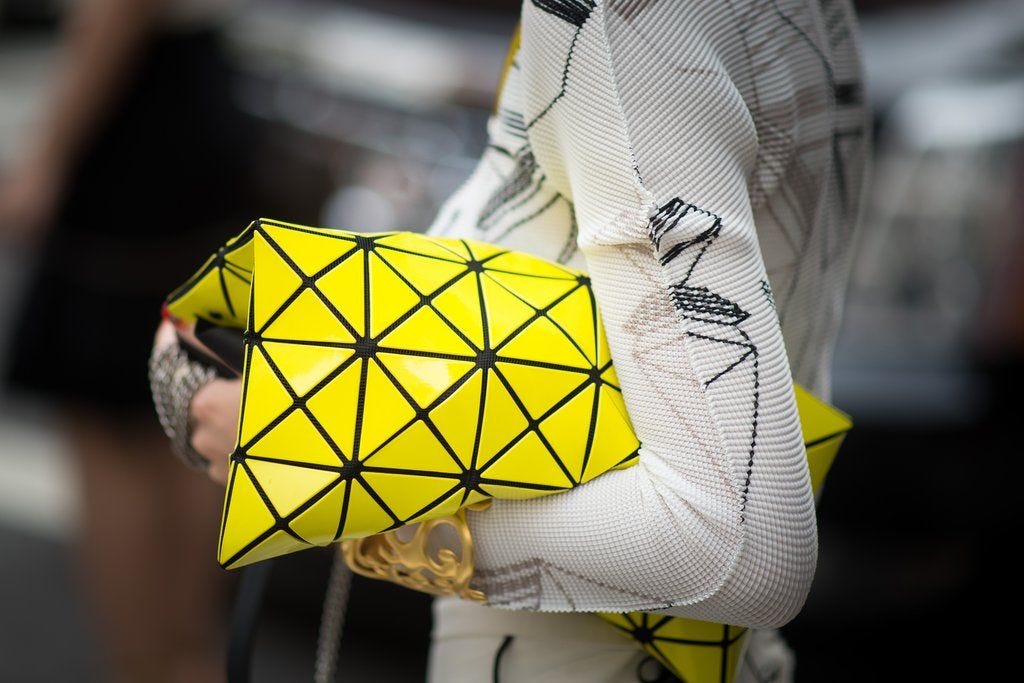
Even pieces that are primarily decorative still have to work on some level. A brooch needs to stay attached. A peplum belt needs to let you sit down. A bag needs to bear weight without ripping at the seams. A shoe needs to be safely walkable.


And importantly: practical doesn’t mean boring. It doesn’t mean unadorned. It doesn’t mean strictly utilitarian. It’s not code for “basic.” It just means the piece holds up in real life; that it meets the functional demands we associate with that kind of item.
This is why I’m sceptical of frameworks that turn practicality into the enemy of creativity — as if the moment we care about wearability we’ve automatically put the breaks on creativity. For me, both Tibi’s “where do you sit on the CP scale?”, and Asta’s beware-the-practicality-as-ceiling pitch both nudge us toward the same trap: treating practicality as something that crowds creative expression.
I’m not convinced that’s way of framing the creativity/practicality nexus is the most helpful starting point. I don’t think we gain much by conceptualising the practical in opposition to creativity (Tibi), or by treating personal style “expansion” as something that requires loosening our grip on practicality (Asta).
For me, it’s more helpful to start from the assumption that good design can do both: evoke feeling and hold up under real-world conditions. If we start there, the cracks in the creativity↔pragmatism framing show up pretty quickly.
Where the Tibi CP scale gets wobbly
Tibi’s ethos, over the past five years or so, has centred around “creative pragmatism.” Not a term Tibi invented, but one they’ve absolutely made their own.
Tibi describe a creative pragmatist as:
An individual who values creativity and pragmatism in daily life and applies both to their style choices. They thrive on personal expression and use fashion to express that creativity. In equal measure, the CP desires functionality and a practicality in how clothing works in their wardrobe. When creativity and pragmatism are in balance, they feel most like themselves (Tibi)
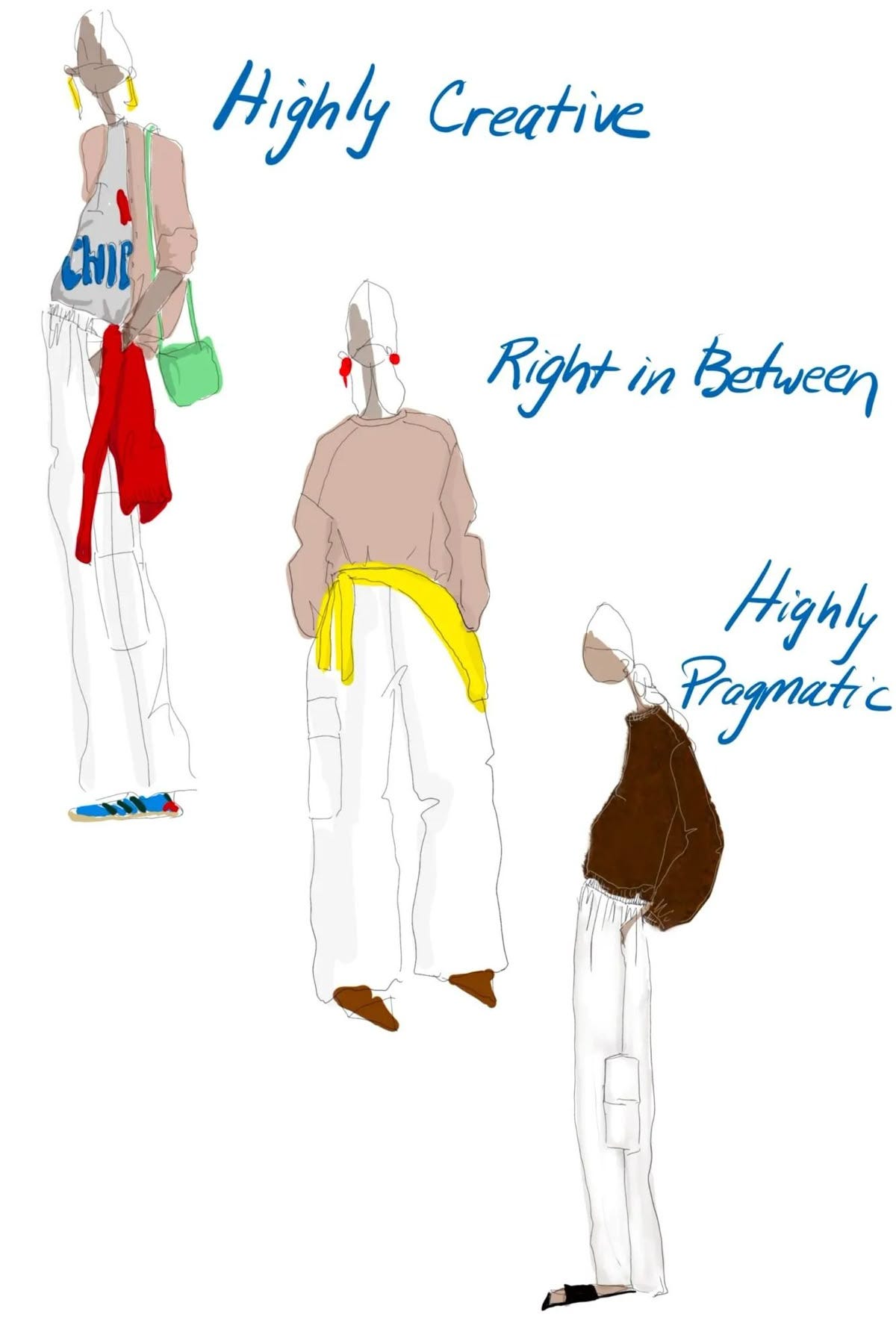
And taking that a step further, Tibi introduced their CP scale.
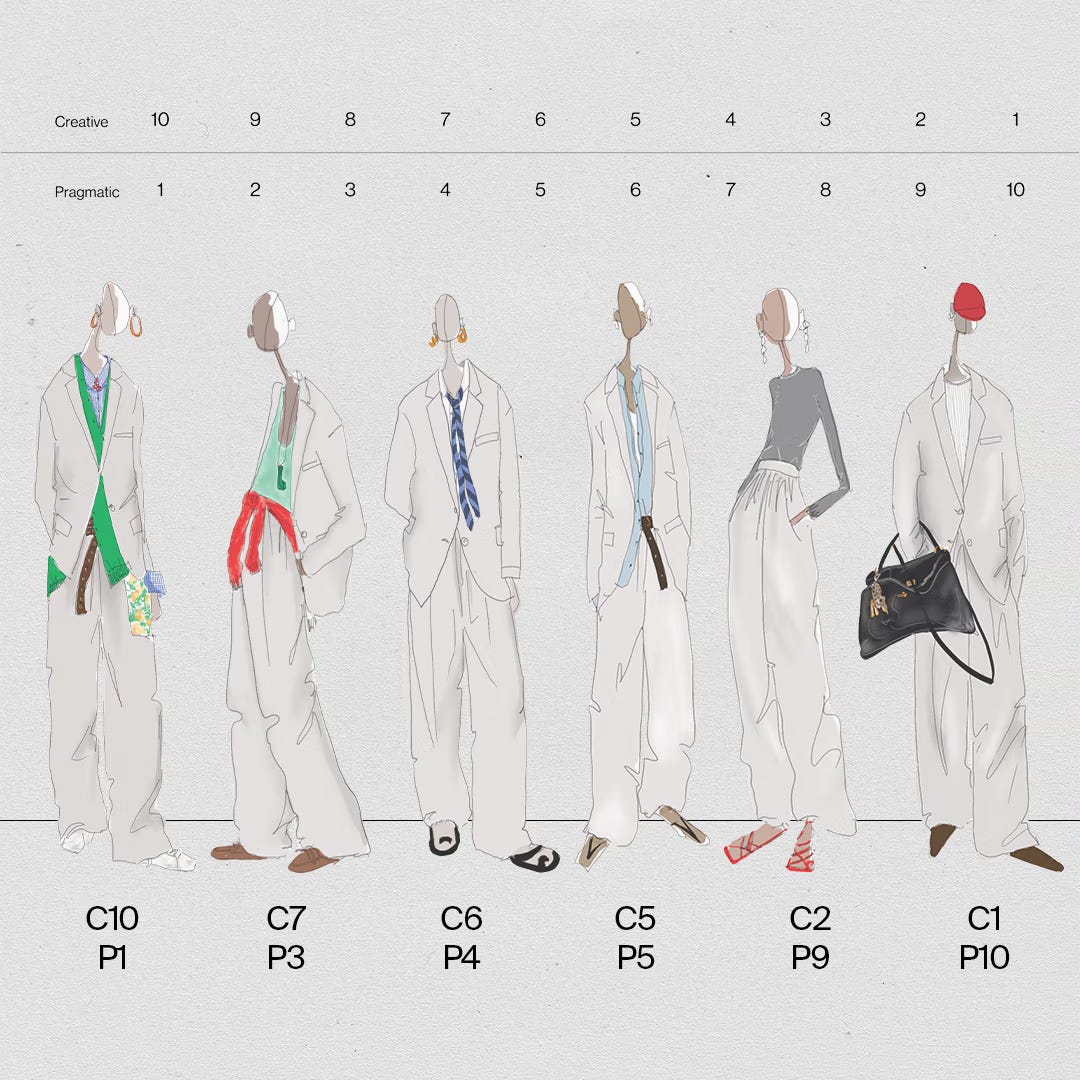
Amy Smilovic frames the value of this CP scale accordingly:
You see, the label “CP” gives a name, permission if you will, to those whose style is Creative, but still Pragmatic. And some days, the scale may tip more creative. And then quite the opposite on others, when we crave to pull things in a bit. And many days, speaking for myself, I land right in the middle.


There’s a lot to like in the intention here. People do want their clothes to feel aligned, and visual misalignment between how we feel and how we look can be genuinely frustrating. But the CP scale sets up a wobbly implication: that being more “creative” means being less “pragmatic,” as if those are competing forces we trade off against each other.
Here’s my interpretation of what the CP scale seems to be measuring in practice.
When Tibi says “creative,” I don’t think they mean creative as a human trait. I think they mean pushed: unexpected, experimental styling relative to the mainstream status quo — i.e. relative to visual/aesthetic convention. And when they say “pragmatic,” by my reading, what they appear to mean is constraint-fit: basic usability in a real wardrobe.
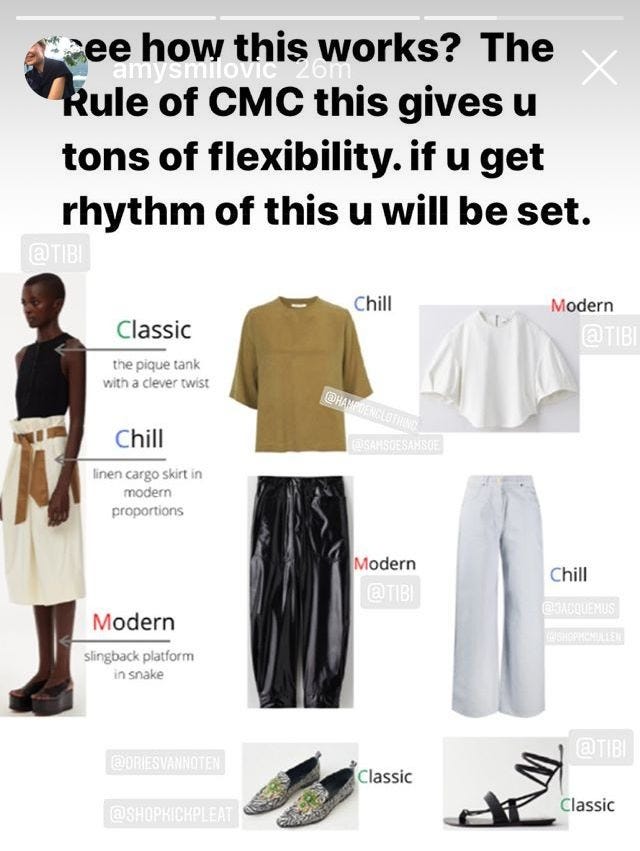
That translation matters, because “creative” is a misleading label for “pushed” design aesthetics. Everyone’s personal style — whatever it is — is creative expression. Tibi defines its own design language as ‘chill, modern, classic’ (aka CMC). That design language can be executed in a more pushed way or a more pared-back way, but neither is “more creative” in any coherent sense. They’re just different degrees of distance from convention within the same CMC vocabulary.
Architecture makes this easier to see. Zaha Hadid, Frank Gehry, and Frank Lloyd Wright have distinct design languages. Some read as more unconventional — more formally “pushed.” Others read as more restrained. But no serious critique would claim the pushed buildings are therefore more creative. They’re simply different dialects. “Pushed” is a visual relationship to convention, not a proxy for how creative someone is.


But even if we generously relabel the CP axis as “pushed ↔ pared-back,” the CP scale still loses me at the point where it insists pushed design must come with reduced pragmatism. The implied trade is: as we dial up “creative” (read: pushed), we should expect “pragmatic” (read: usability) to decrease.
That’s not creativity. That’s just permission for poor design.
It’s also a category error, because “pragmatism” is an approach — a way of making decisions under real conditions — not a property a garment has at P1 versus P10. If what we’re really talking about is wearability, let’s just call it that. Or better: constraint-fit.
In architecture, a ‘pushed’ building can be wildly dysfunctional, but it can also be designed to meet users’ needs beautifully. A restrained building can be delightful to use, or it can fail completely. What matters is whether the design holds up under the brief. Good design evokes feeling and delivers on function. It doesn’t ask for untenable sacrifices and call that sacrifice “creative.”
The “practicality is limitation” argument
There are many conversations and think pieces that riff on this Tibi-esque logic, discussing creative expression as it butts up against everyday practicalities.
Asta at Fit Happens published this thoughtful piece last week and it struck a chord, though I couldn’t disagree more with the underlying framing. Here’s the core of her argument that I want to respond to:

Now. I want to be careful here, because I am not about to tell you that practicality is bad and you should just buy everything that makes you feel something and ignore your actual life.
If your life genuinely requires maximum ease—you’re running at full speed, you need clothes that can survive your schedule without asking anything of you—then filtering for practicality isn’t a limitation. It’s a rational, intelligent strategy. Build your wardrobe that way. Own it. Truly.
But.
If you want expansion—if you have a restlessness about your closet you can’t quite name, if you keep saving things to your phone that you never buy, if you look at certain things and feel something move—then practicality has quietly shifted from being your floor to being your ceiling. And most people don’t notice when that shift happened.
Practicality started as a tool. Then became a limitation.
And Asta continues:
Here’s what a wardrobe built entirely on practicality looks like: fine. It functions. Nothing is precious. Everything goes with everything. You can throw most of it in the wash. It all makes complete sense.
But also, you miss that zha zha when you’re getting dressed.
I get the impulse behind this. I also get the frustration embedded in it: people admire a more “zha zha” wardrobe, and then they ask questions that sound like they’re trying to turn everything back into sweatpants.
But for me, the diagnosis doesn’t land, because it rests on the same false binary as the CP scale: that expansion and wearability are competing goals.
We can want expansion and we can want wearability. Those wants are not mutually exclusive.
In fact, for most people who care about clothes, they’re intertwined. We want pieces that make us feel something and survive the life we’re actually living.
Where Asta frames questions like “but will it wrinkle?” as sneaky limitation, I see something else a lot of the time: a rational response to real constraints. The implication that we really must just ‘worry less’ about all these things; well, that can read as a little context-blind. Not maliciously; I’m not suggesting that at all. Just blind to the fact that for some lives, the penalties for ignoring the practical realities of dressing and maintaining wardrobes are real.
I don’t buy the claim that caring about maintenance, comfort, wearability (or indeed sustainability while we’re at it!) predestines someone to a wardrobe that “misses the zha zha.” It’s a miscategorisation to treat wearability questions as a propensity towards stifling bold creativity.
If anything, I’d argue the opposite: for us consumers, working within constraints often demands more imagination, not less. And it’s very much the same for those on the production side, whether in architecture, product design, or fashion — constraints don’t dilute creative practice. They generate it.
Revisiting the CP scale
Where to from here?
If we want to chart personal style, I’m tempted to ignore the creativity↔pragmatism slider and step away from the false binary between those pieces that make us feel something and pieces that tick the practicality boxes.
We all have taste (aka a design aesthetic): that whole orbit of things that pique our curiosity. And within that orbit sits our personal style: a smaller subset of things we actually want to wear, and which feel good on the body.
We also all have practicality boxes. They’re individual. They’re shaped by climate, body, lifestyle, work norms, budget, wardrobe space, care capacity, and so on — all the stuff that makes up the weeks we actually live.
Good personal style lives where those two things meet. The sweet spot is the overlap between what we’re drawn to (our style) and what actually works for us (ticked boxes).
Which is why I’d map good personal style on two axes:
Visual charge (ie. our taste) (quiet ↔ pushed)
Constraint-fit (ie. our check boxes) (low wearability ↔ high wearability)
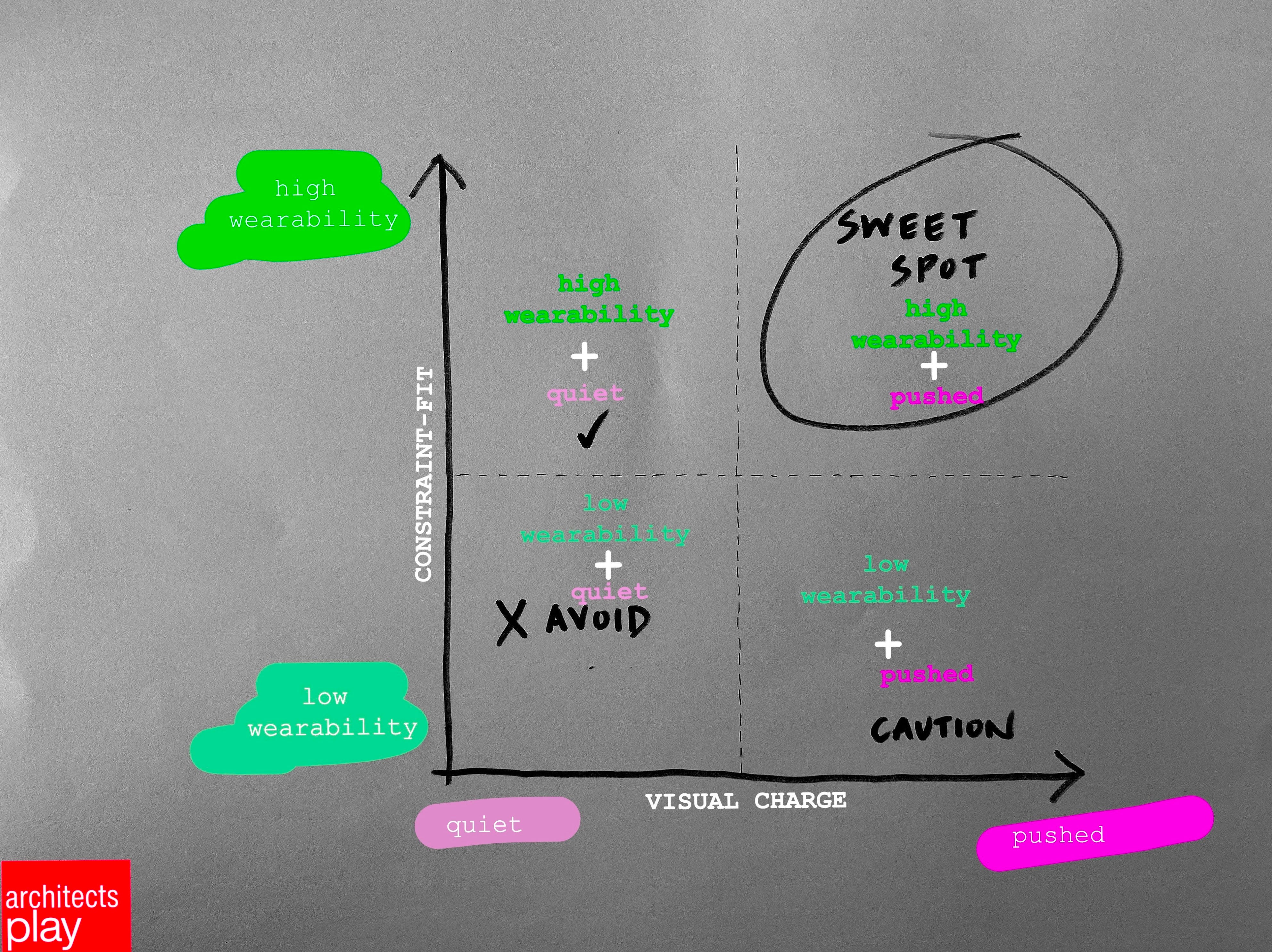
Constraint-fit isn’t “could I wear this, in theory?” It’s “will this work in my real week?”
This model makes space for what we all already know intuitively, mapped into quadrants:
Low expression + low constraint-fit is the dead zone. Nothing’s working. Don’t buy. Avoid! (that’s bottom left)
High expression + high constraint-fit is the sweet spot: the pieces that make you feel something and that show up in your real week. (that’s top right)
High expression + low constraint-fit is proceed-with-caution territory. Sometimes the risk is worth it, for that very special piece. And sometimes the risk results in never-worns.
This approach also gets us out of the weird moralising trap of the CP slider. A pushed piece can be brilliantly wearable. A pared-back piece can be unwearable. Pushed doesn’t mean “less functional,” and functional doesn’t mean “less expressive.”
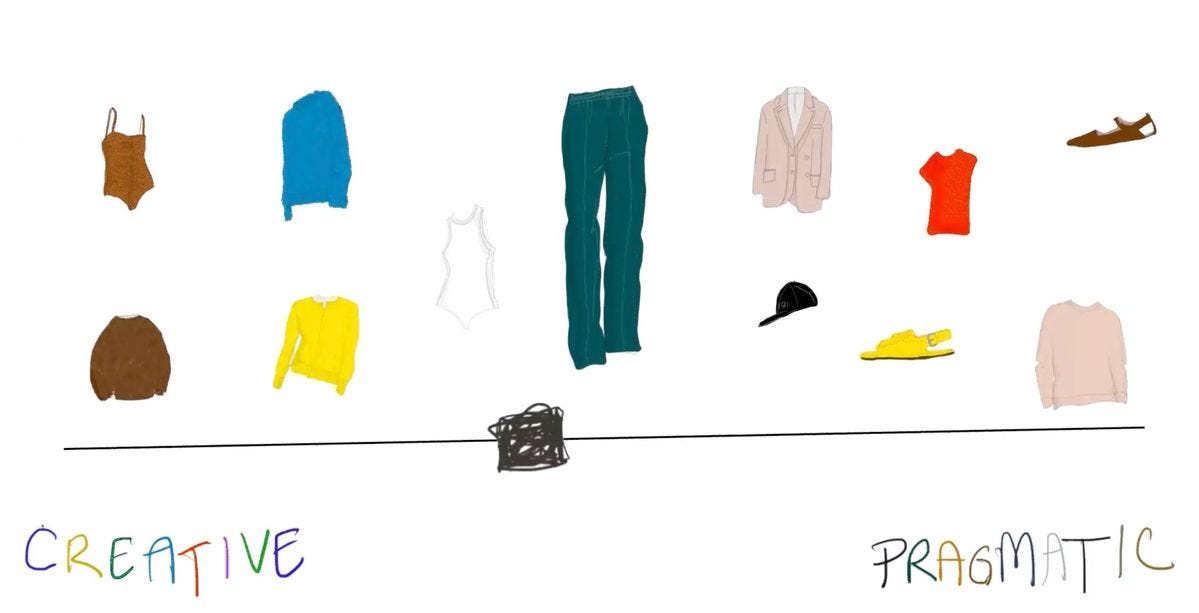
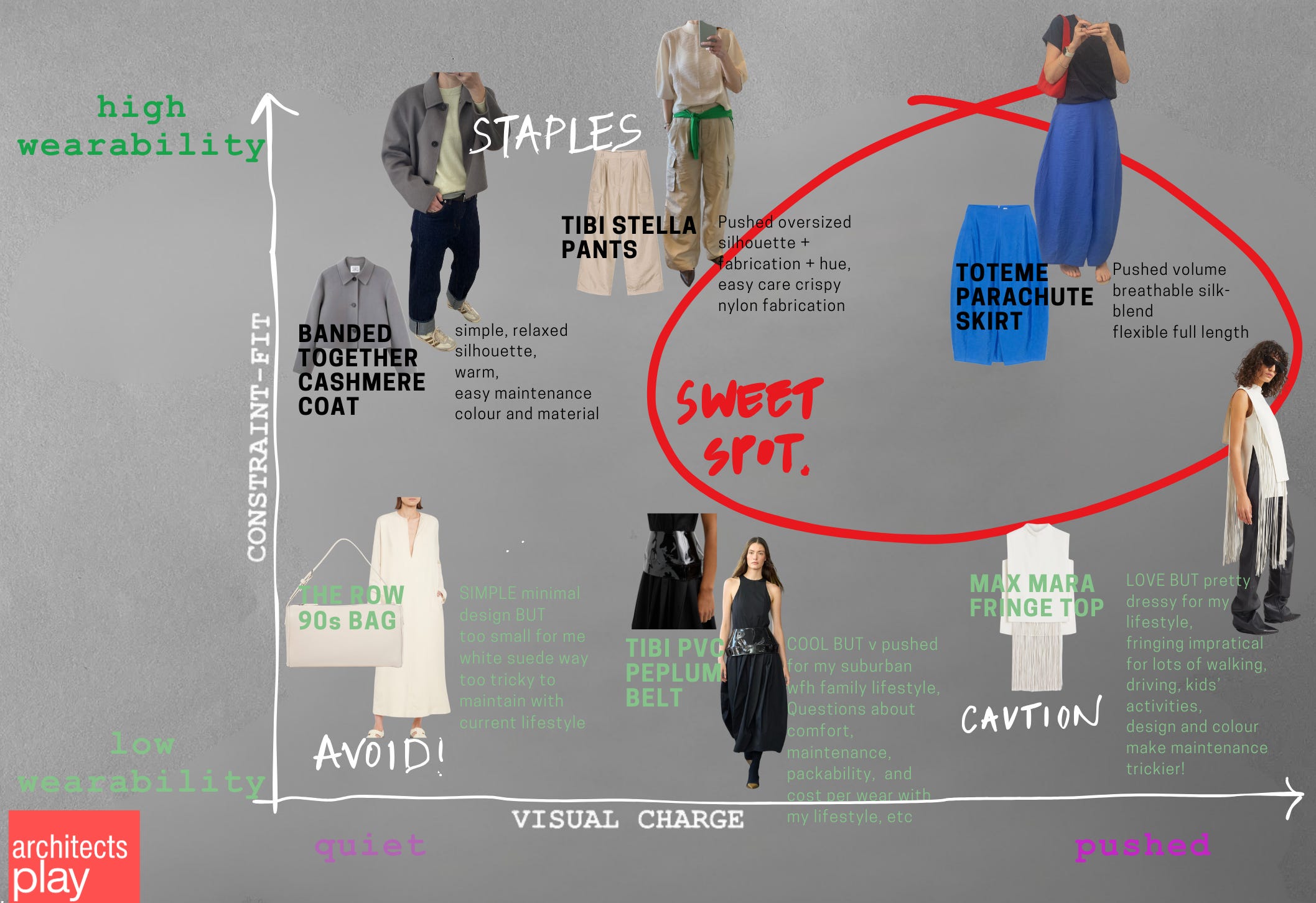
To make this less theoretical, I plotted a few of my own pieces. It won’t map neatly onto your life — my constraints are warmer weather, WfH, kids, budget and a very casual baseline — but that’s kind of the point. It’s why we do want to tal
A better question than “is it practical?”
When practicality questions bubble up, I don’t think ignoring our gut is the way forward.
Sometimes “impractical” is just code for bad design — beautiful maybe, but not fit for purpose. Think shoes that are a trip hazard. Or bags that can’t hold anything without ripping at the seams. These are obvious no-gos.
But beyond the obvious, the more useful question is: what kind of “impractical” is this? Because not all friction is the same.
Sometimes it means the piece doesn’t fit the weeks we’re actually living. It’s not for us, right here, right now.
Sometimes it means the piece could fit our week — but it sits at the edge of what we’re used to. Maybe it feels a little ‘too’ pushed. That’s where not-yet pieces live, and yes, sometimes we can talk ourselves out of just ripping the labels off and wearing the thing through lack of nerve.
But most of the time, I think we should trust our instincts. Only we know our own matrix of constraints — budget, lifestyle, climate, body, care capacity and so forth — and if we’re asking questions, it’s often because we do know ourselves. That’s not limitation. That’s data.
And that’s the piece I want to hold onto: if we’re chasing the zha zha, the answer isn’t to abandon practicality as a north star. It’s to look for the version of the design aesthetic where the constraints have been resolved beautifully — where expression and wearability work together, not bargain against each other.
Because the best pieces for us aren’t the ones that require a different life. They’re the ones that meet the life we have AND still give us that full body YES!
p.s. Circling back to Tibi…
There’s probably a better way to map Tibi style DNA than the CP scale. I’d throw out “pragmatism” as an axis entirely, because pragmatism is a mindset — a way of orienting ourselves — not a metric of a person or a garment.
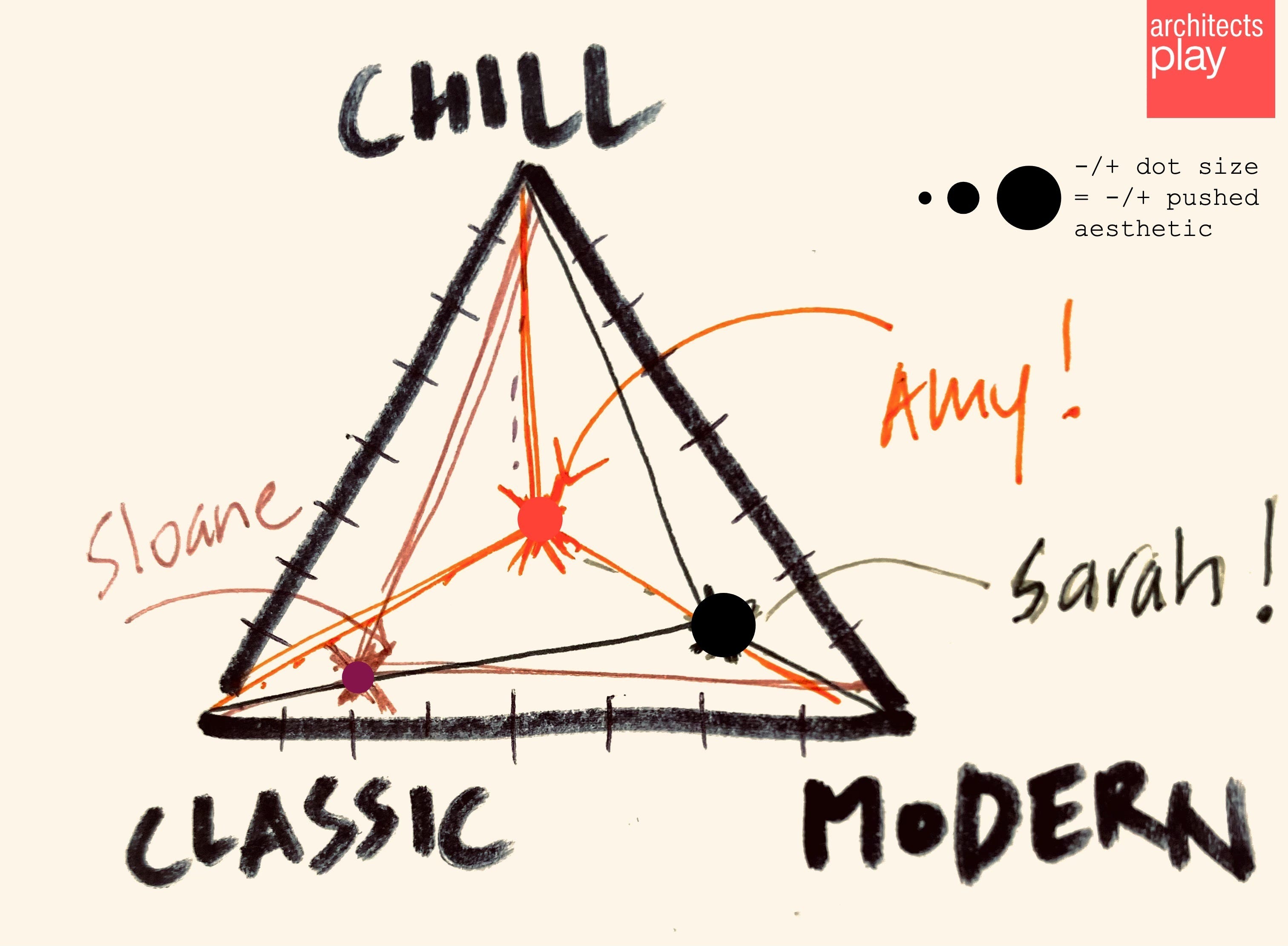
A triangle/ternary plot — chill / modern / classic at the vertices — would get us further than the current CP slider. Founder Amy Smilovic seems pretty balanced across the three aesthetics, so I’d put her near the middle. Others might lean more classic (Sloane, perhaps), or more modern.
Then I’d capture what the CP scale is really trying to describe as a separate overlay: degree of push — how far from convention you’re taking that same CMC vocabulary on a given day. Visually, I’d show that with dot size: a small dot for a more pared-back execution, a larger dot for a more pushed one. Same CMC language, just spoken at different volumes.
Tibi’s own brand philosophy keeps evolving. Some people will remember the early “rule of CMC” framing — combine something classic, something modern, something chill. That’s not really the narrative now, which is fine. But it does underline the point: these frameworks are changeable. They’re not laws of physics.
I’d love to hear how (and how much!) your own personal constraints feature in your wardrobe decisions. Do you have a different interpretation of Tibi’s CP scale? And if you’ve talked yourself into (or out of) a piece despite (or because of) its “impracticalities”, how did it work out?
If I could I would restack every line. You articulated far more eloquently what I tried to say in comments to Asta’s posts.
I do think some people lean too much into practicality. Eg staying in sweatpants or leggings all day if they’re wfh before it’s the easiest.
But I find Tibi often uses it to excuse poor design or quality.
Meg, you perfectly explained why I’ve been feeling so confused about the CP scale and the idea that creativity is the opposite of pragmatism. I’ve just finished the book and I’m quite new to Tibi concepts, but it never made sense to me why the two couldn’t go hand in hand. As someone who always prioritizes function and what works for my real life and personal constraints, it sometimes made me feel like I wasn’t pushing the creative side when in reality I’m just looking for pieces that balance both.